

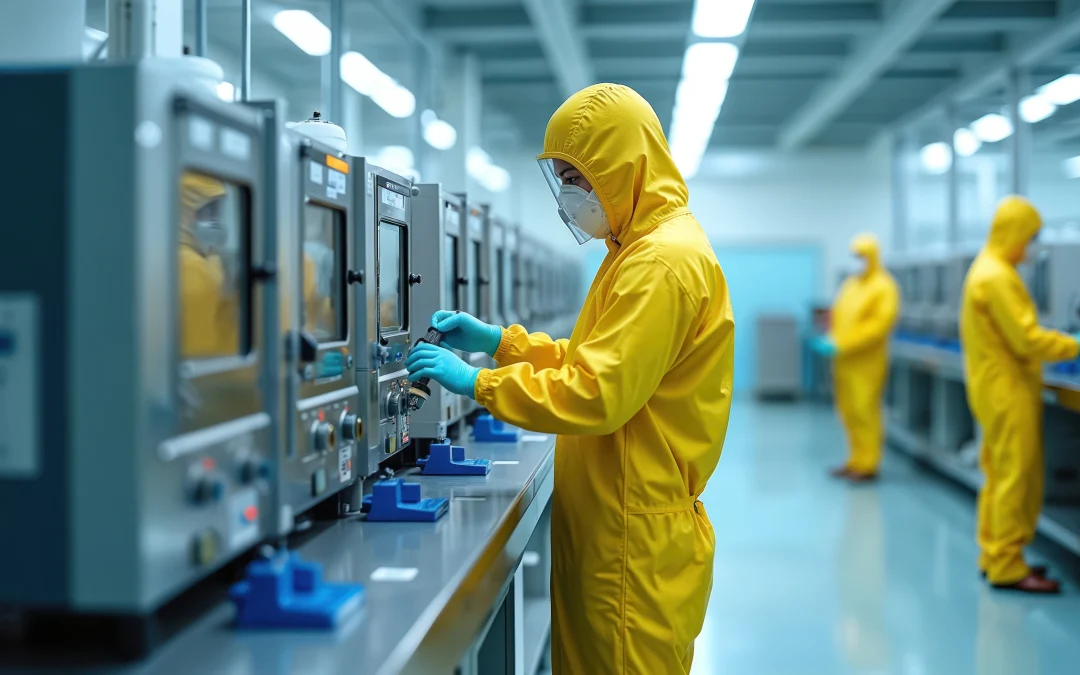
The pharmaceutical industry presents some of the most demanding environments for Local Exhaust Ventilation (LEV) systems.
From powder handling and dispensing through to laboratory processes and production environments, pharmaceutical facilities often involve hazardous substances, airborne particulates, solvent vapours and contamination-sensitive operations that require carefully engineered control measures.
Did you know that high-potency active pharmaceutical ingredients (HPAPIs) are becoming increasingly popular and common in drug development pipelines? While working with highly potent chemicals and elements, it becomes imperative for pharmaceutical manufacturers to practice and comply with good manufacturing practice (GMP).
While LEV principles remain consistent across industries, capturing contaminants at source before they can enter the breathing zone, pharmaceutical applications frequently require a far more considered approach than standard industrial extraction systems.
Understanding the Risks in Pharmaceutical Environments
Many pharmaceutical manufacturing and laboratory processes generate airborne contaminants that can present serious health and operational risks if not adequately controlled.
These may include:
- Active pharmaceutical ingredients (APIs)
- Fine powders and dusts
- Solvent vapours
- Potent compounds
- Chemical fumes
- Cross-contamination risks between processes
Without effective extraction and containment, these contaminants can:
- expose operators to hazardous substances,
- compromise product quality,
- impact clean environments,
- create housekeeping issues,
- and lead to non-compliance with COSHH requirements.
In some cases, even relatively small airborne releases can become significant concerns due to the potency of materials being handled.
This is why pharmaceutical LEV systems often need to go far beyond simply “moving air”.
Why Pharmaceutical LEV Systems Are Different
Unlike many general industrial LEV applications, pharmaceutical environments often involve a combination of:
- operator exposure risks,
- containment requirements,
- process sensitivity,
- filtration considerations,
- and environmental control requirements.
A system that works perfectly well in a fabrication workshop may be entirely unsuitable in a pharmaceutical production area.
Factors that frequently require specialist consideration include:
- Powder behaviour and particle size
- Containment requirements
- Airflow patterns within controlled spaces
- Filtration requirements
- Recirculation risks
- Ease of cleaning and maintenance
- Integration with existing cleanroom or HVAC systems
- Pressure relationships between rooms and processes
Poorly designed systems can create unintended consequences such as:
- turbulence around operators,
- ineffective contaminant capture,
- dust escape during dispensing,
- contamination transfer,
- or disruption to controlled environments.
Common Pharmaceutical LEV Applications
Pharmaceutical LEV systems can take many forms depending on the process, risk profile and operational requirements.
Powder Dispensing & Weighing Areas
Powder handling is one of the most common pharmaceutical LEV applications.
During dispensing and weighing activities, fine powders can easily become airborne if extraction is inadequate. In these situations, properly engineered containment booths or extraction systems help capture contaminants at source while maintaining operator usability.
Key considerations often include:
- capture velocity,
- operator movement,
- booth airflow design,
- filtration,
- and maintaining containment during material transfer.
Pharmaceutical Manufacturing Processes
This includes processes such as:
- blending,
- granulation,
- coating,
- tablet production,
- and packaging
They may all require extraction solutions depending on the substances involved and the exposure risks identified during COSHH assessments.
In many cases, extraction systems must balance effective contaminant control with practical production requirements and equipment access.
Laboratory Extraction Systems
Laboratories within pharmaceutical environments may involve:
- solvent handling,
- chemical mixing,
- sample preparation,
- testing activities,
- or fume-generating processes.
These applications often require carefully designed extraction solutions to protect operators while maintaining stable laboratory conditions.
Depending on the application, solutions may include:
- flexible extraction arms,
- enclosed extraction systems,
- ventilated enclosures,
- or dedicated LEV systems integrated into laboratory workflows.
The Importance of Competent LEV Design
One of the biggest misconceptions surrounding LEV is that installation alone guarantees compliance.
In reality, system performance depends heavily on:
- correct hood selection,
- airflow design,
- duct sizing,
- fan specification,
- discharge arrangements,
- commissioning,
- and ongoing maintenance.
The Health & Safety Executive’s HSG258 guidance makes it clear that LEV systems must be properly designed, commissioned and maintained if they are to effectively control exposure.
In pharmaceutical environments, competent design becomes even more important due to the potential consequences of inadequate containment.
At Vent-Tech, we believe pharmaceutical LEV systems should be engineered around the actual process and operational risks, not simply installed as generic extraction systems.
Not Every Pharmaceutical Process Requires the Same Solution
A common mistake in pharmaceutical extraction projects is assuming that one system type suits every application.
In reality, pharmaceutical LEV solutions can range from:
- localised extraction arms,
- downflow booths,
- partial enclosures,
- high-filtration systems,
- Through to fully bespoke containment solutions.
The appropriate approach depends on factors such as:
- the substances involved,
- process frequency,
- operator interaction,
- airborne release potential,
- and the required level of containment.
This is why early consultation and competent site assessment are often critical in determining the right approach.
LEV Testing, Commissioning & Ongoing Compliance
Even a well-designed pharmaceutical LEV system requires ongoing verification to ensure it continues performing effectively.
Under COSHH Regulation 9, LEV systems must undergo Thorough Examination & Testing (TExT) at suitable intervals, at least every 14 months depending on the application.
However, compliance should not simply become a “tick-box exercise”.
Effective ongoing LEV management should include:
- regular maintenance,
- filter inspection and replacement,
- airflow verification,
- operator checks,
- and monitoring of system performance over time.
In critical environments, ongoing monitoring and early identification of performance issues can help prevent operational disruption and exposure risks before they escalate.
Taking a Practical, Compliance-Focused Approach
Pharmaceutical organisations need LEV systems that are:
- effective,
- practical,
- maintainable,
- and engineered with compliance in mind.
At Vent-Tech, we work with clients across a wide range of containment-critical environments to help develop extraction solutions aligned with HSG258 principles and COSHH requirements.
Whether supporting:
- pharmaceutical manufacturing,
- powder handling,
- laboratory environments,
- or containment-sensitive processes,
Our focus remains on delivering engineered LEV solutions designed to protect people, processes and operational compliance.
Speak to Vent-Tech
If you are reviewing extraction within a pharmaceutical environment or planning a new process involving powders, fumes or airborne contaminants, our team at Vent-Tech can help.
Our team can support with:
- LEV consultancy
- Pharmaceutical extraction design
- Installation
- Commissioning
- LEV testing
- Servicing
- and ongoing compliance support.
To discuss your pharmaceutical LEV requirements, contact Vent-Tech today.