

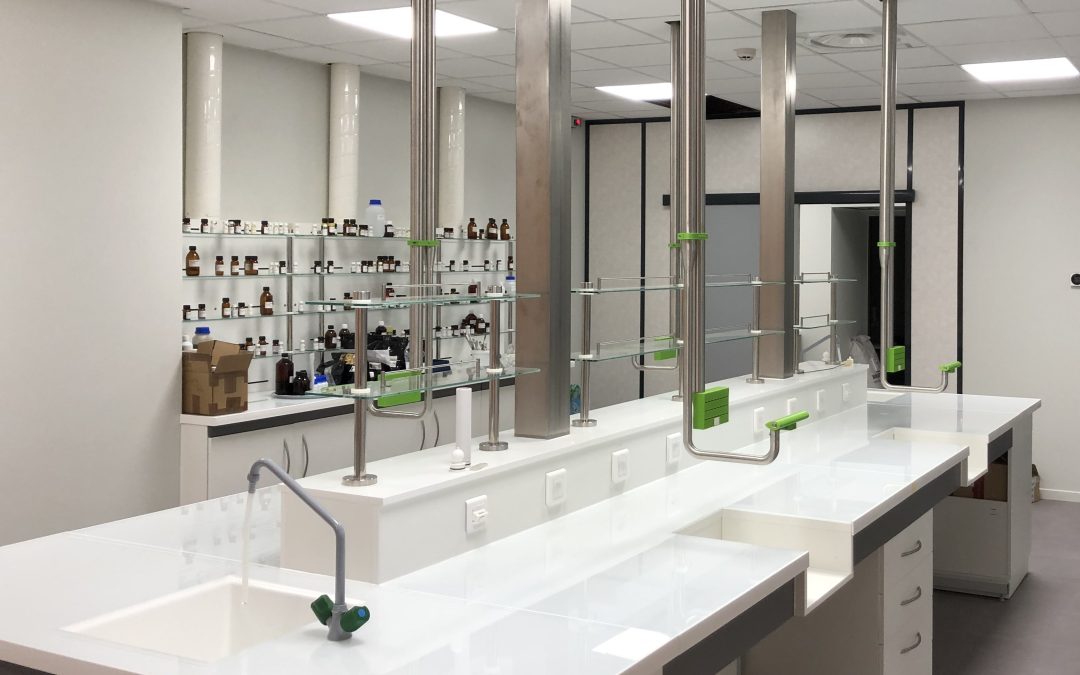
Why smarter LEV design is becoming just as important as compliance.
When most organisations think about Local Exhaust Ventilation (LEV), their priorities are usually straightforward: protect employees, comply with COSHH regulations and ensure hazardous substances are effectively controlled.
Those objectives will always remain the primary purpose of any well-designed LEV system. However, another important consideration becoming increasingly important, particularly for universities, pharmaceutical companies and research laboratories, is the cost of operating laboratory extraction systems.
With rising energy prices and increasing pressure to reduce carbon emissions, many organisations are taking a closer look at how their buildings consume energy. Different functions, such as heating, cooling, and ventilation, account for varying levels of energy consumption.
While facilities focus on optimising energy levels, extraction is rarely questioned and whether there is an extraction unit that can help reduce energy consumption, thereby reducing energy costs.
At Vent-Tech, we believe a bespoke LEV design should focus on the 3Ps:
Protection
Protecting people from hazardous airborne contaminants.
Performance
Delivering effective contaminant capture while optimising system efficiency.
Planet
Reducing energy consumption and supporting more sustainable laboratory operations.
Laboratory Ventilation Designs Looking Beyond Compliance
Traditionally, laboratory extraction has been designed with one clear objective: effectively capture contaminants and protect the operator.
That remains absolutely essential.
But modern laboratory ventilation design allows us to ask another important question.
Can we achieve the same level of protection in a more energy-efficient way?
For certain laboratory applications, the answer may be yes.
Rather than relying solely on higher extraction volumes, advances in energy efficient LEV now allow some processes to achieve effective contaminant capture using carefully engineered airflow and significantly lower extracted air volumes.
The result is the potential to reduce the amount of conditioned air removed from the laboratory, helping to lower the energy required to heat, cool and replace that air.
Importantly, this is not about reducing safety standards. It is about applying the right engineering solution to the right application.
Every Laboratory Is Different
One of the biggest misconceptions in laboratory ventilation design is that there is a single solution suitable for every process.
In reality, laboratories perform an enormous range of activities, each with different hazards, contaminants and operational requirements.
Some applications require conventional laboratory extraction systems with higher extraction volumes.
Others may benefit from more energy-efficient approaches.
This is why experienced laboratory LEV consultancy begin by understanding the process before recommending any extraction solution.
By assessing the substances being handled, how operators interact with the process and the overall laboratory environment, engineers can determine the most appropriate extraction strategy for each application.
What Makes a Laboratory Ventilation System More Energy Efficient?
A more energy-efficient system isn’t simply about extracting less air. It’s about extracting the right amount of air for the process being carried out.
Depending on the application, this may include:
- Demand controlled laboratory ventilation
- Variable Air Volume (VAV) laboratory controls
- Process-specific airflow design
- Improved contaminant capture
- Lower airflow extraction where appropriate
When combined with good engineering and risk assessment, these approaches can help reduce energy use while maintaining safe laboratory operation.
A New Approach to Laboratory LEV Design
At Vent-Tech, we have always believed that effective LEV design is about more than simply selecting fans and ductwork.
Our role is to engineer solutions that balance:
- Operator protection
- COSHH compliance
- Practical operation
- Long-term reliability
- Whole-life operating costs
As part of this approach, we are expanding the range of solutions available to our design engineers by incorporating specialist energy-efficient extraction technologies where they are appropriate.
This isn’t about replacing conventional LEV systems.
It’s about giving our engineers another option when designing the most effective solution for a client’s process.
For some laboratories, that may mean little change.
For others, particularly facilities operating multiple laboratory workstations, it could present an opportunity to reduce ongoing operating costs while maintaining effective contaminant control.
Is Energy Efficient Laboratory Ventilation Right for Every Laboratory?
No. Every laboratory has different processes, hazards and performance requirements.
Some laboratories require high extraction volumes to safely control hazardous substances, while others may benefit from lower airflow solutions or demand-controlled systems.
The key is selecting the right solution for the application rather than applying the same design to every laboratory.
That’s why every project should begin with understanding the process, identifying the hazards and determining the level of protection required.
Smarter LEV Design
We believe the future of laboratory extraction is not about one product or one technology.
It is about making better engineering decisions.
Every project should begin with the same questions.
- What is the process?
- What are the hazards?
- What level of protection is required?
- Can this be achieved more efficiently?
That’s the philosophy behind what we call Smarter LEV Design.
Rather than applying the same solution to every project, we believe every laboratory deserves a laboratory extraction system designed around its specific requirements, balancing safety, performance, compliance and operational efficiency.
Looking Ahead
As organisations place greater emphasis on sustainability and reducing operational costs, sustainable laboratory ventilation will continue to play an increasingly important role in modern laboratory design.
Over the coming months, we’ll be sharing more information about where energy-efficient laboratory extraction solutions are most effective and the types of facilities that could benefit.
As always, our focus remains the same: designing the right solution for every application.
Because good LEV design isn’t just about meeting today’s requirements.
It’s about creating systems that continue to deliver value for years to come.
Speak to Our Laboratory LEV Consultants
If you’re planning a new laboratory, refurbishing an existing facility or reviewing the performance of your current laboratory extraction system, we’d be happy to help.
Our design engineers can assess your application and advise whether an energy-efficient solution could form part of a smarter laboratory ventilation design.
Good LEV design isn’t about choosing a product.
It’s about choosing the right engineering solution.