

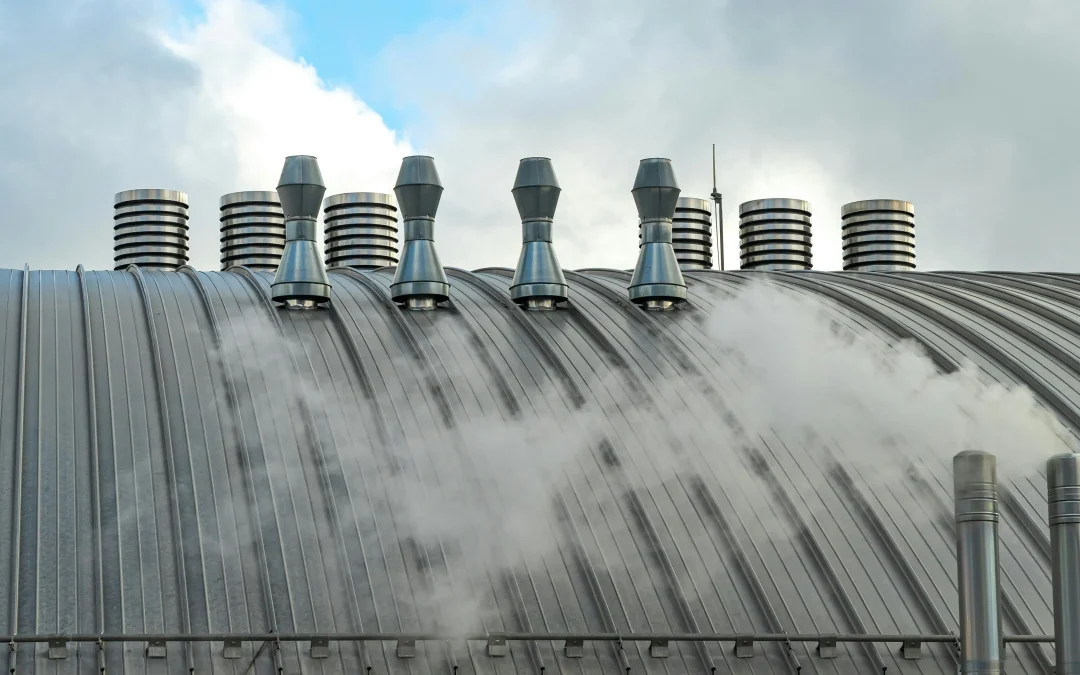
Why Stack Discharge and Plume Dispersal Matter More Than Most People Realise
If you run a process that generates hazardous fumes, dust, or vapours, you probably already know that Local Exhaust Ventilation (LEV) is a legal requirement under COSHH. This means an extraction system is responsible for capturing the contaminant at source, ducting it away from the breathing zone, and discharging it into the atmosphere via a stack, helping to protect both workplace and environmental safety.
At this point, you might assume the job is done, but is it really?
The question that often gets missed, and most LEV designers don’t formally analyse it, is what happens to that contaminant once it leaves the stack.
The Problem With Assuming “Up and Away” With the Discharge Stack
The intuitive answer is that contaminated air rises, disperses, and disappears. And most of the time, that’s roughly what happens. But “roughly” isn’t good enough when you’re dealing with hazardous substances, environmental permits, or a site where air intakes, windows, or doorways are anywhere near your discharge point.
Under the wrong conditions, discharged contaminants don’t just drift away. They can:
- Recirculate back into the building through air intakes, open doors, or roof-level openings, exposing workers to the very substance the LEV system was designed to remove
- Affect neighbouring premises, particularly relevant on dense industrial sites or in urban locations
- Breach environmental permit conditions set by the Environment Agency or local authority
- Create localised ground-level concentrations that exceed safe levels in specific weather conditions
None of these outcomes are visible during a normal TExT visit. They show up in air monitoring results. They show up in complaints from neighbouring businesses. And occasionally, they show up in enforcement action.
The root cause, in most cases, is a design issue, not an operational one. Stack height, diameter, discharge velocity, and location all affect plume behaviour. Getting them right matters.
What Determines Where the Plume Goes?
Plume behaviour is governed by a combination of factors, some within your control and some not.
The Stack Used for Plume Dispersal
Height above the roofline, internal diameter, and discharge velocity all affect how forcefully the contaminant is projected into the atmosphere and at what point it begins to mix with the surrounding air. HSG258 provides guidance on minimum discharge velocities and stack height relative to nearby structures, but these are minimum requirements, not a guarantee of safe dispersal in all conditions.
The Building and Surroundings
Air flowing over and around a building can create recirculation zones on the leeward side, areas where air movements are unpredictable and contaminated air can be drawn back down. The proximity of your stack to the building edge, roof features, and neighbouring structures all influence this.
Meteorological Conditions
Wind speed, wind direction, atmospheric stability, temperature, humidity, and cloud cover all affect how a plume behaves. A stack that performs well on a clear, windy day may behave very differently in calm, stable conditions or when wind direction shifts.
This is why a rule-of-thumb approach to stack design, i.e. “3 metres above the roofline and you’re fine”, doesn’t tell the full story.
Atmospheric Dispersion Modelling: What It Is and Why It Matters
Atmospheric Dispersion Modelling is the process of using computational software to simulate how a discharge plume behaves under real-world conditions. Rather than assuming safe dispersal, it calculates it.
At Vent-Tech, we use ADMS (Atmospheric Dispersion Modelling System) software, one of the leading tools used by environmental consultants, regulators, and industrial designers to model plume behaviour from LEV discharge systems.
The process works like this:
- We model your LEV system: stack dimensions, discharge temperature, airflow rate, and contaminant concentration or quantity
- We model your building and surroundings: the physical geometry that influences airflow and turbulence around the discharge point
- We apply real meteorological data: wind speed and direction, temperature, humidity, cloud cover, and time of day, based on data relevant to your site location
- We predict plume behaviour: ground-level concentrations at key locations, the risk of recirculation, and the influence of nearby structures
The output is a clear, documented analysis that tells you whether your stack arrangement is adequate or whether height, diameter, location, or discharge velocity needs to change.
When Should You Commission a Plume Dispersal Analysis?
- As part of a new LEV design, this is the ideal time. If your system discharges to the atmosphere, plume dispersal analysis can be built into the design process before anything is installed. It’s far easier and cheaper to adjust stack height or location on a drawing than on a completed installation.
- When you have permit conditions to satisfy: if your site operates under an Environment Agency permit or has local authority conditions on emissions, a dispersion analysis provides documented evidence of compliance. Get in touch, and we can talk through what applies to your specific situation.
- When you suspect recirculation: if air monitoring results are unexpectedly high, if workers report odours or irritation when the LEV system is running, or if a TExT report has flagged concerns about discharge effectiveness, a dispersion analysis can diagnose the cause.
- When your process or site changes: if you’ve added new extraction points, increased process volumes, changed the substance being extracted, or made changes to the building that affect airflow, the original stack design assumptions may no longer hold.
A Bolt-On to Design or a Standalone Service?
Plume Dispersal Analysis works best when it is integrated into the LEV design process from the outset. For new systems, we can include it as part of our Stages 2 and 3 design work, ensuring that the stack specification is based on modelled performance, not assumptions.
For existing systems, it can be commissioned as a standalone assessment. To carry it out, we need two key pieces of information: the temperature of the air in the stack, and the concentration or quantity of the hazardous substance being discharged. If you have an existing system and are unsure of these parameters, we can discuss the options, including commissioning a stack emissions survey.
LEV design has always been about more than getting the extraction right at the hood. A well-designed system captures the contaminant, conveys it safely, and discharges it in a way that protects workers, neighbours, and the environment.
Plume dispersal is the final link in that chain. It deserves the same rigour as the rest of the design.
At Vent-Tech, our Managing Director, Adrian Sims, is a contributing author of BESA TR40, the industry’s definitive guide to LEV good practice, and was the first person in the UK to hold the BOHS Certificate of Competency in Control. TR40 is clear that discharge arrangements should be properly considered as part of any LEV design. Atmospheric dispersion modelling is how you do that with confidence.
Talk to us
If you’re specifying a new LEV system with atmospheric discharge, if you have an existing stack you’d like to verify, or if you operate under permit conditions that require documented evidence of safe dispersal, we’d be glad to help.
Email: enquiries@vent-tech.co.uk
Phone: 0117 964 7945
Web: www.vent-tech.co.uk/lev-design/