

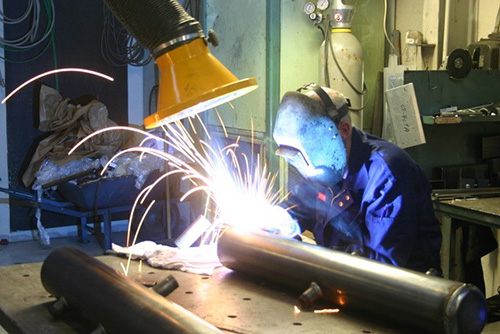
Metal fabrication processes naturally generate significant health hazards, particularly when heating, cutting, and joining materials. Welding fumes are a complex mix of toxic gases and fine particles created during high-temperature joining tasks on the workshop floor.
HSE guidance confirms there is no known safe level of exposure to welding fume, indoors or outdoors, and requires effective engineering controls on virtually all welding work regardless of job duration. Relying on basic background ventilation or simply opening doors and windows is no longer accepted as adequate control under the Control of Substances Hazardous to Health (COSHH) Regulations 2002.
Achieving full LEV compliance means designing extraction to the principles set out in HSG258 and BESA’s Technical Recommendation 40 (TR40), the industry’s good-practice framework for LEV design, installation and maintenance. Working with specialists like Vent-Tech helps fabrication workshops meet that standard, not just achieve adequate ventilation.
Understanding the Health Risks of Welding Fumes in Metal Fabrication
In any metal fabrication shop, joining materials using MIG, TIG, or arc methods releases airborne manganese, iron oxides, and gases, substances with Workplace Exposure Limits (WELs) set out in EH40. Inhaling these microscopic particles on a daily basis leads to severe long-term respiratory problems, and manganese exposure specifically is linked to irreversible neurological harm.
Both the International Agency for Research on Cancer (IARC) and the HSE now classify welding fumes as carcinogenic to humans, with links to serious lung and kidney illness. Even short-term exposure can cause metal fume fever, a painful flu-like condition that affects worker wellbeing, attendance, and overall workshop productivity.
Because fine fume particles remain suspended in workshop air for hours, uncontained smoke quickly spreads across the entire facility. Protecting your workforce requires targeted local extraction controls that intercept emissions before they ever reach a welder’s breathing zone.
Key Legal Requirements and LEV Compliance for Fabrication Workshops
Under the COSHH Regulations 2002 (Regulation 7) and its Approved Code of Practice (L5), employers have a legal duty to prevent or adequately control employee exposure to airborne hazardous substances. HSE guidance is explicit that general background ventilation alone is not sufficient control for welding, cutting, or joining fumes, whatever the workshop size.
Achieving complete LEV compliance means installing purpose-built extraction equipment capable of capturing toxic emissions directly at the arc or torch, backed by a logbook and O&M manual as required under COSHH ACoP L5. Under COSHH Regulation 9, every LEV system must also undergo a Thorough Examination and Test (TExT) at a maximum interval of 14 months, some processes require it more often, so the actual frequency should always be confirmed against a proper risk assessment rather than assumed.
Non-compliance can lead to an HSE Improvement Notice or, in more serious cases, a Prohibition Notice that stops the affected work immediately, with prosecution as a last resort. But the real reason to get this right isn’t avoiding enforcement, it’s that a properly designed and maintained LEV system is the difference between a workforce that’s actually protected and one that only looks compliant on paper.
Essential Extraction Design Elements for Controlling Welding Fumes
An effective extraction layout relies on selecting the right ;.hoods, flexible extraction arms, or specialised on-torch extraction units, sized and positioned in line with the capture velocity principles set out in HSG258. Hoods must be placed close to the weld point so that capture velocity overcomes general workshop draughts and movement, Vent-Tech typically designs to achieve exposure at a tenth of the relevant EH40 workplace exposure limit, well inside the safe working zone rather than just under it.
Ductwork systems must be sized correctly to maintain the transport velocities recommended in BESA guidance (DW/144 for sheet metal ductwork), preventing heavy dust or fume particulate from settling inside the pipes. Suitable filtration then clears the airflow before discharging clean air safely outside or back into the building.
COSHH ACoP L5 requires many LEV systems to carry a visual or audible indicating device confirming the system is working correctly, modern LEV sensor technology builds on that legal minimum with automated real-time monitoring of airflow velocity and filter pressure drop, alerting operators the moment suction starts to fall rather than waiting for the next scheduled check.
Best Practices for Maintaining Systems and Ensuring LEV Compliance
Simply installing extraction equipment is not enough; routine preventative maintenance, typically at three-monthly intervals, per BESA TR40, is essential to keep suction power working efficiently between annual TExT visits. Overloaded filters, damaged flexible hoses, and loose duct connections can quietly reduce capture performance without operators noticing any difference.
Welders must also be properly trained, a duty under COSHH Regulation 12, to position extraction hoods correctly as they move along different joint lines and workpieces. Even the best-designed extraction system will fail if the collection hood is left too far from the active plume.
Establishing a simple daily maintenance schedule, recorded in the system logbook, helps spot minor mechanical faults before they turn into major equipment breakdowns. Regular checks on fan belts, filters, and hood seals ensure your workshop maintains consistent extraction performance and continuous compliance.
Conclusion: Creating a Safer Workplace with LEV Compliance
Controlling airborne hazards in the metal fabrication industry is vital for protecting worker health and satisfying legal obligations. While background ventilation keeps workshops comfortable, only targeted local extraction guarantees that toxic smoke and dust are removed before causing harm.
Taking a proactive approach to system design, daily hood positioning, and regular maintenance keeps your workforce properly protected and your compliance record straightforward to demonstrate. Investing in extraction infrastructure designed to recognised BESA and HSE standards creates a safer, cleaner, and more productive manufacturing environment for everyone.
If you need practical guidance on updating your workshop extraction setup or ensuring your facility meets current COSHH and EH40 requirements, help is available. Vent-Tech’s design team includes BOHS-accredited LEV practitioners and a contributing author of BESA TR40, please visit our contact page to discuss your specific fabrication needs.